stringer bell
Community Leader
-
Joined
-
Last visited
Everything posted by stringer bell
-
Good comparison to the Marlins when Miggy was a rookie. Lowell was a solid 3B and the Marlins wanted Cabrera's bat in the lineup. If Sano is ready, then maybe he can play outfield for a while. If Sano bombs in left, switch it up. If Plouffe reverts to a less than average player, Sano moves in as the regular at third.
-
"Fool me once, shame on me. Fool me twice, shame on you". Aaron Hicks has been the starting center fielder for the Twins the last two Opening Days. He was a thorough disappointment in 2013, eventually getting demoted to AAA and not being recalled in September. With the bar set considerably lower in 2014, Hicks still fell far short of expectations and offered a lot of content for sports analysts with his supposed lack of preparation and short-lived decision to abandon switch hitting. Hicks spent much of this summer in New Britain and Rochester, but was recalled in September. Aaron got 70 plate appearances in September with the big club. There was talk of better focus and more confidence, but the result was something short of scintillating. Hicks hit .250 with a .648 OPS. His OBP was an entirely acceptable .348, but he had only three extra-base hits in those seventy plate appearances. My "eye test" observation was equally unimpressed. Hicks hit the ball hard only a handful of times that I can remember. Getting good wood on the ball is a part of his hit tool that seems to be missing to this point. On top of the offensive struggles, there have been whispers and inferences that Hicks is not committed to being a great baseball player. He skipped winter ball last year. He supposedly didn't know who was pitching one day and showed up late for a non-mandatory session with the training staff so that the manager felt he couldn't use him on that particular day. And then there is the switch-hitting debacle. Hicks has always been better as a right handed hitter. Many on this site thought the answer was simple--abandon switch hitting. Without consulting his manager and not discussing it with anyone else on the team, to my knowledge, Hicks decided to give up switch hitting. When it became obvious he needed work to have an acceptable chance against right handers and because he was able to rehab after a disabling injury, Hicks was sent to Double A and then optioned there when his rehab time ended. The idea was to work on the swing, but shortly after being optioned, Hicks went back to switch hitting. The platoon splits are pretty stark--Hicks' combined OPS was .615 but his OPS was .792 against left handed pitchers and only .512 vs right handers. To me, this is the contrast between tools and skills. Everyone remarks that Hicks has tools and he does--good speed, strong throwing arm, and big athletic body. The tools are good, but they aren't exceptional, except for maybe his outstanding throwing arm. The skills haven't caught up with the tools. Maybe they never will. I think Hicks' absolute upside is Austin Jackson--supposedly the next great all-around center fielder, who has been pretty good, but never an All-Star and a guy that hasn't become a high average hitter, accomplished power hitter, stolen base threat or Gold Glove defender. Given the Twins' dearth of outfield options, Hicks will most likely get another chance to make good on his potential. I maintain that what is best for his development and ultimately best for the team is to go to Triple A and build his confidence by dominating at that level. He has just turned 25 so there is a chance that he is a late bloomer who will thrive when he "gets it". The Twins, however, can't assume that he will. Fool them three times, shame on them.
-
-
Entering 2014, Eduardo Escobar was pegged by most as a standard-order utility infielder. He was a switch-hitter with a pretty good glove and OK speed who had demonstrated the ability to capably fill in at short, third and second. There was some chatter that EE shouldn't make the Twins coming out of spring training, but most viewed him as a good fit for the utility infielder role. Some wanted to see "Eddie 400" in 2014--that is at least 400 at-bats-- to see what the still-young Venezuelan could do with more consistent playing time.The early season gave Escobar his chance. Pedro Florimon, already seen as a subpar hitter, got off to a woeful start and Escobar got several early starts at shortstop. The rest is, as they say, history. Escobar hit .357 in April and backed that up with a .322 (.865 OPS) May. Florimon was demoted and Escobar became the de facto starting shortstop. Escobar returned to earth in June and July--his average fell to .274 at the end of June--and then he stabilized. Eduardo finished with a .275 batting average and his OPS ended at .721, good for a 102 OPS+. The season qualifies as a breakthrough. Escobar had more plate appearances than in his previous three years combined (over a year and a half in the majors). Escobar set career highs in almost every offensive category, played solid defense at three infield positions (metrics vary among the three) and showed durability. Esco still has some issues. He struck out 93 times and walked only 24, keeping his OBP relatively low at .315. Many, including myself, doubt he can replicate his extra-base numbers (35 doubles among 43 XBH). Escobar is not an explosive runner and thus will never have excellent range. All of this limits his upside to about what he was this year. Escobar ended with dramatic platoon splits. In just over 300 ABs, he had only a .654 OPS as a left-handed hitter, while in 131 at-bats as a right-handed hitter, his OPS was .877. It does appear that Eduardo has been a stronger RH batter throughout his limited major league career. If someone had said going into the season that the Twins would have a young switch-hitting shortstop who could field capably, and be an asset at the bottom of the order, most Twins fans would have been ecstatic and guaranteed the guy a starting spot for years. However Escobar's rise coincided with the emergence of Danny Santana, who has the speed and explosiveness that Eddie 400 lacks. Next year's role for Escobar is up in the air. He may revert to a 3-position utility guy or he could become a "10th starter" filling in for multiple infielders, but not having a specific position. If injuries occur, Escobar could slide in for whoever gets hurt. If Santana stays in the outfield, perhaps he could hold shortstop. Click here to view the article
-
There is a little bit of SSS going on there, but based on 2014, that is the best lineup the Twins can put out there. The thing is we're assuming that breakouts Santana, Vargas, Escobar and Schafer (in Minnesota) all sustain what they did last year. I, for one, don't want anything to do with Aaron Hicks starting the 2015 in Minnesota. I am on board for signing Masterson, as well. He will turn 30 in spring training and has experienced a successful season as recently as 2013.
-
-
-
Responding to all of the posts in this thread: First, and foremost, the Twins need more players that are talented in all facets of the game. On the current roster only Dozier is a good bet to win a lot of games with glove, bat and legs. Mauer isn't fast, but he's a good base runner, is becoming a good defensive first baseman and has HOF hitting credentials, despite last year's disappointment. "Triple threat" guys aren't plentiful and usually cost a lot of money. I agree that Arcia has the tools to be adequate or better as a right fielder. Whoever is on the coaching staff should make a personal project of turning Arcia into a more complete hitter and a competent defender. It will take work, but he has the tools and I don't think there's any doubt that he wants to excel. Defense. If the Twins want to get better defensively, they need to stick with guys up the middle. I firmly believe that defense matters more at catcher, short, second, and center field. You can win with a Manny Ramirez or Delmon Young on a corner, but you need better-than-average gloves up the middle and continuity. Danny Santana will be starting at one of the up-the-middle positions. I hope he doesn't split his time. Individual defense--Escobar is decent at the most demanding position that lines up in fair territory. He won't make many "oh my" plays, but he turns outs into outs. Dozier had a terrific year with the glove in '13, not so much this year, but on the whole he's a good defensive second baseman. I still think he was better than average this year despite the high number of errors. I didn't see enough of Santana at short to say "yea or nay" on his performance there. I know he has the arm and the range.
-
Masterson got traded to the Cards in midseason--not eligible.
-
I've been thinking about Rosario for a while. He had a disappointing season in New Britain, but the young man can hit and he would fill the bill for the Twins as far as being a good fielder, with some speed in either left or center. It certainly will require both a good AFL and spring training for Rosario to threaten for a roster spot, but if the Twins don't acquire an outfielder there is room for someone to step up.
-
Entering 2014, I had Eduardo Escobar pegged as a standard-order utility infielder. He was a switch-hitter with a pretty good glove, okay speed who had demonstrated the ability to capably fill in at short, third and second. There was some chatter that EE shouldn't make the Twins coming out of spring training, but most viewed him as a good fit for the utility infielder role. Some wanted to see "Eddie 400" in 2014--that is at least 400 at-bats to see what the still-young Venezuelan could do with more consistent playing time. The early season gave Escobar his chance. Pedro Florimon, already seen as a subpar hitter, got off to a woeful start and Escobar got several early starts at shortstop. The rest, as they say, is history. Escobar hit .357 in April and backed that up with a .322 (.865 OPS) May. Florimon was demoted and Escobar became the de facto starting shortstop. Escobar returned to earth in June and July--his average fell to .274 at the end of June--and then he stabilized. Eduardo finished with a .275 batting average and his OPS ended at .721, good for a 102 OPS+. The season qualifies as a breakthrough. Escobar had more plate appearances than in his previous three years combined (over a year and a half in the majors). Escobar set career highs in almost every offensive category and played solid defense at the three infield positions (metrics vary) and showed durability. Esco still has some issues. He struck out 93 times and walked only 24, keeping his OBP relatively low (.315). Many, including myself, doubt that he can replicate his extra base numbers (35 doubles among 43 XBH). Escobar is not a explosive runner and thus will never have excellent range. All of this limits his upside to about what he was this year. Escobar ended up with dramatic platoon splits. In just over 300 ABs, he had only a .654 OPS as a left handed hitter, while in 131 at-bats as a right handed hitter, his OPS was .877. It does appear that Eduardo has been a stronger RH batter throughout his limited major league career. If someone would have said going into the season that the Twins would have a young switch hitting shortstop who could field capably and be an asset at the bottom of the order, most Twins fans would have been ecstatic and guarantee the guy a starting spot for years, however Escobar's rise coincided with the emergence of Danny Santana, who has the speed and explosiveness that Eddie 400 lacks. Next year's role for Escobar is up in the air. He may revert to a 3-position utility guy, he could become a "10th starter", filling in for multiple infielders, but not having a specific position. Perhaps he can hold shortstop, if Santana stays in the outfield. If injuries occur, Escobar could slide in for whoever gets hurt.
-
Honestly, I don't expect much more than one free agent pitcher signing, someone like McCarthy or Masterson, perhaps up to Santana. There is a need for a good defensive outfielder who can hold his own at the plate, but almost all of the available free agents are bat-first players and there aren't many who would significantly improve the defense. If the Twins get an outfielder, it probably will be through trade. Secondly, it looks like the drumbeat has really started to bring up the top prospects, ready or not. Buxton would be expected to skip two level after playing less than fifty games last year, Sano would be expected to skip one level after playing zero games in 2014. Just not feasible IMHO. Finally, Shane, I know you really like Herrmann, I just don't know why. In parts of three seasons, he has 276 PAs and an OPS+ of 53. I wouldn't call him a defensive whiz behind the plate or in the outfield and he will turn 27 this year. The much-derided Pedro Florimon has a higher OPS+ (57) despite putting up a -11 in 86 PAs this year.
-
Halsey, I said that Dozier's personality is the polar opposite of Knoblauch. Away from the field, Dozier reminds me of Cuddy, while Knoblauch was driven and intense all the time. On the field, Dozier is pretty intense and seems determined to get better and make the most of his abilities, which summarizes Knoblauch's time with the Twins.
-
Joe Mauer is a former MVP and a three-time batting champion. As a catcher, he has won five Silver Sluggers and three Gold Gloves. These are Hall of Fame credentials for a 31-year-old. Last year, Mauer was shut down after suffering a concussion. The symptoms were present until well into the offseason. Mauer and his advisors decided it was time to give up catching. With the exit of Justin Morneau, a move to first base was an easy call.I was among those who thought that Mauer would be able to play more games and provide more power when he abandoned catching. For the 2014 season, I was wrong. Mauer had a career-low .277 batting average and managed only 518 plate appearances. Mauer's OPS and OPS+ approached career lows, as well, and he managed only four homers, about one homer per 130 plate appearances. In addition, Joe continued a disturbing trend of increasing strikeouts. He fanned 96 times, about 18.5 percent of the time, compared to maxing out at less than 12 percent his first eight years in the league. His strikeout percentage has increased dramatically each of his last three seasons. This year, Mauer suffered injuries, missing games with back spasms, an elbow injury and mid-year went on the DL with an oblique injury that reportedly bothered him for most of the rest of the season. It has also been reported that Mauer was rusty coming in to the spring because he didn't have his normal workout regimen due to the concussion. Combined with the adjustment of switching full time to first base, Mauer had an uncomfortable first half of the season. At the All-Star break, he was hitting .271 with a .695 OPS. Joe picked up the pace after the All-Star break. His OBP after the break was .397 and his OPS after the break was .805. Mauer also had fairly dramatic platoon splits. Against left-handers, he managed only four extra base hits and had an OPS of .654 (.776 against righties). No one can dispute that Mauer's numbers were far below career norms. The question is whether he is going hard in to decline mode or whether he can recapture his Hall of Fame- worthy form from his first ten years in the majors. No one really knows and no one knows the extent of the injuries, including the concussion he suffered in 2013. My speculation is that Mauer has long been a premier player using his somewhat unique approach. I think that he now needs to adjust that approach. He needs to be more aggressive early in the count and find pitches to drive. He also needs to be stronger, so that some of his 360-foot fly balls turn into 380-foot home runs. Defensively, Mauer looked uncomfortable at first at the beginning of the year. By playing 100 games at first, he got more comfortable and became a pretty good defensive first baseman. All of that matters little if he can't come back and again be a top hitter. Click here to view the article
-
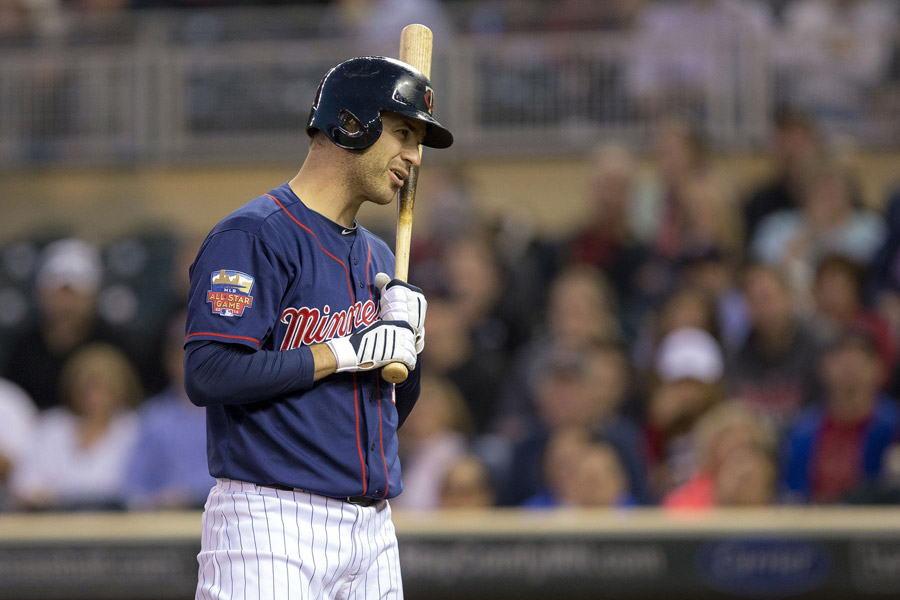 I was among those who thought that Mauer would be able to play more games and provide more power when he abandoned catching. For the 2014 season, I was wrong. Mauer had a career-low .277 batting average and managed only 518 plate appearances. Mauer's OPS and OPS+ approached career lows, as well, and he managed only four homers, about one homer per 130 plate appearances. In addition, Joe continued a disturbing trend of increasing strikeouts. He fanned 96 times, about 18.5 percent of the time, compared to maxing out at less than 12 percent his first eight years in the league. His strikeout percentage has increased dramatically each of his last three seasons. This year, Mauer suffered injuries, missing games with back spasms, an elbow injury and mid-year went on the DL with an oblique injury that reportedly bothered him for most of the rest of the season. It has also been reported that Mauer was rusty coming in to the spring because he didn't have his normal workout regimen due to the concussion. Combined with the adjustment of switching full time to first base, Mauer had an uncomfortable first half of the season. At the All-Star break, he was hitting .271 with a .695 OPS. Joe picked up the pace after the All-Star break. His OBP after the break was .397 and his OPS after the break was .805. Mauer also had fairly dramatic platoon splits. Against left-handers, he managed only four extra base hits and had an OPS of .654 (.776 against righties). No one can dispute that Mauer's numbers were far below career norms. The question is whether he is going hard in to decline mode or whether he can recapture his Hall of Fame- worthy form from his first ten years in the majors. No one really knows and no one knows the extent of the injuries, including the concussion he suffered in 2013. My speculation is that Mauer has long been a premier player using his somewhat unique approach. I think that he now needs to adjust that approach. He needs to be more aggressive early in the count and find pitches to drive. He also needs to be stronger, so that some of his 360-foot fly balls turn into 380-foot home runs. Defensively, Mauer looked uncomfortable at first at the beginning of the year. By playing 100 games at first, he got more comfortable and became a pretty good defensive first baseman. All of that matters little if he can't come back and again be a top hitter.
-
In my book, Brian Dozier was the Twins best position player in 2013. He had a better year in 2014 and again, I think he was the best everyday player on the team. Dozier is a study in contrasts--he isn't a big guy, but has led the team in home runs the last two years. He is a converted shortstop who has become very comfortable as a second baseman. Most guys his size are told to "use the whole field", but he is perhaps the most pronounced pull hitter on the team, certainly among the right-handed hitters.In 2014, Dozier had an up and down season. He started slowly, lifted his average through June and then tailed off. Dozier hit a bunch of homers early and continued hitting an occasional long ball until the All-Star break. The power tailed off from there and he was stuck on 20 homers for a long time. He finished with 23 long balls and 21 steals, one of only a handful of Twins to ever reach 20 in both categories. One improvement Brian made throughout the season was his ability to take a free pass. He had 89 walks (3rd in the AL) and was hit by nine pitches giving him 98 passes to first base. Despite having nearly the same batting average as in 2013, he increased his OBP by 33 points to .345. Dozier scored 112 runs (second in the AL), the most by a Twin this century. He drove in 71 runs despite hitting first or second almost exclusively. Dozier's defense was highly appreciated by TD regulars in 2013 and there was carryover into 2014. He did make more than his share of web gems, but he also committed too many errors (15). Dozier is a better than average defensive second baseman, but he sometimes needs to fight the urge to try to make the spectacular play. While their personalities are polar opposites, Dozier reminds me of another Twins second sacker, Chuck Knoblauch. Each year Knoblauch added another facet to his game. Dozier added selectivity this year and I expect next year he'll be a better situational hitter or better bunter or perhaps win a Gold Glove. I think he has the desire to win and excel and the Twins need more of that. Dozier has solidified his position with the Twins. If he doesn't improve at all, he still is a better than average player who can win a game with his bat, his glove and his legs. His durability, power, defense and the fact that he'll be under team control for four more years make him desirable to other teams, but I believe he has great value for a Twins team that may be on it's way up. Expect Dozier to have another solid year in 2015 and be a major contributor when the Twins are again contenders. Click here to view the article
-
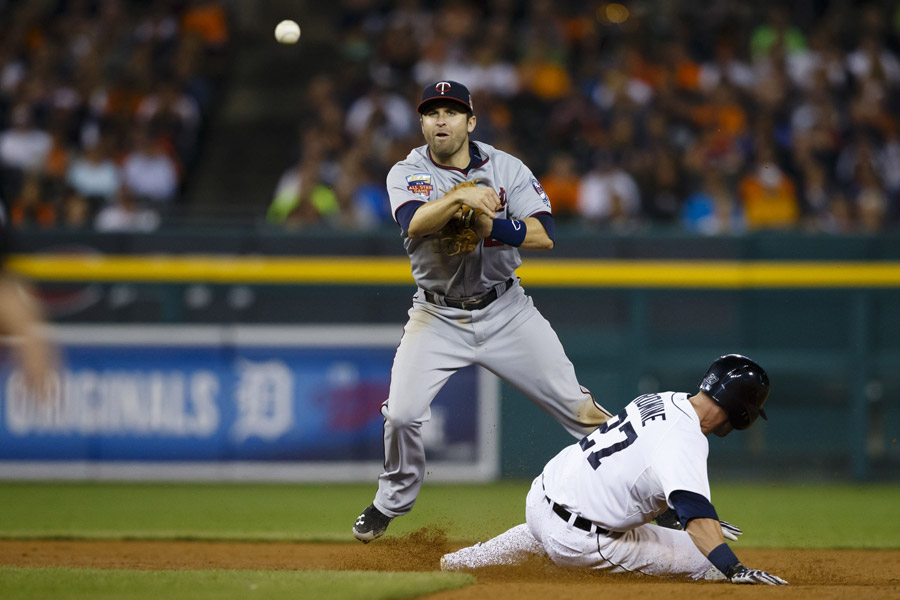 In 2014, Dozier had an up and down season. He started slowly, lifted his average through June and then tailed off. Dozier hit a bunch of homers early and continued hitting an occasional long ball until the All-Star break. The power tailed off from there and he was stuck on 20 homers for a long time. He finished with 23 long balls and 21 steals, one of only a handful of Twins to ever reach 20 in both categories. One improvement Brian made throughout the season was his ability to take a free pass. He had 89 walks (3rd in the AL) and was hit by nine pitches giving him 98 passes to first base. Despite having nearly the same batting average as in 2013, he increased his OBP by 33 points to .345. Dozier scored 112 runs (second in the AL), the most by a Twin this century. He drove in 71 runs despite hitting first or second almost exclusively. Dozier's defense was highly appreciated by TD regulars in 2013 and there was carryover into 2014. He did make more than his share of web gems, but he also committed too many errors (15). Dozier is a better than average defensive second baseman, but he sometimes needs to fight the urge to try to make the spectacular play. While their personalities are polar opposites, Dozier reminds me of another Twins second sacker, Chuck Knoblauch. Each year Knoblauch added another facet to his game. Dozier added selectivity this year and I expect next year he'll be a better situational hitter or better bunter or perhaps win a Gold Glove. I think he has the desire to win and excel and the Twins need more of that. Dozier has solidified his position with the Twins. If he doesn't improve at all, he still is a better than average player who can win a game with his bat, his glove and his legs. His durability, power, defense and the fact that he'll be under team control for four more years make him desirable to other teams, but I believe he has great value for a Twins team that may be on it's way up. Expect Dozier to have another solid year in 2015 and be a major contributor when the Twins are again contenders.
-
-
While I don't doubt that Buxton will be a premium center fielder, I'm not convinced he is there now, especially after being inactive for almost a year. It seems to me that Hicks was previewed as an excellent defender, but he's not graded out as even above-average. I am hoping that Buxton can shake off the rust quickly in the AFL. I don't think there is any guarantee that Buxton will dominate in Arizona. Obviously, it would be wonderful to have a premier talent in the lineup every day.
-
Why left over right? Arcia has plenty of arm for right field, and Target Field has the smaller area to patrol in right. Arcia will never be speedy or have great range.
-
-
Without going back to BB Ref, I believe several teams were able to improve by 15 games or more multiple times, meaning that historically there is better than a one in ten chance to make such an improvement. Not all large jumps are the same, this year's Angels and Marlins both improved substantially (20 and 15 games respectively) but the reasons were totally different--the Angels got relatively healthy and built a bullpen, while the Marlins have added minor league talent for some time and that talent was on display in Florida. There has to be enough talent, but I submit that the Twins have enough talent to improve 15 games. Also, I doubt the Twins would "sell their souls" to compete next year. In the hypothetical of being on the periphery of the race in July/August, I would expect the dramatic move the Twins would make would be promoting young talent, not trading for a good, but declining player.
-
Plouffe is a major league starting third baseman. Hicks? Needs to start the season in AAA, even if it means Jordan Schafer is the center fielder.
-
I fully expect to see both Sano and Buxton in he majors sometime in 2015. I think the idea of using a year of service time for them to be in over their heads would by doubly bad for the Twins front office. Secondly, I really don't see the need to push Sano because Plouffe is a capable third sacker. OTOH, if Buxton shines in the AFL and then is the best OF in the spring, I can almost see him coming north quickly, if not on Opening Day. First of all, he would offer better defense than we've seen in center and perhaps move a good defender to left, improving the defense there. Secondly, even if he struggles, his great speed might keep him out of batting slumps. I'm sure the front office really would like to get 6.1 to 6.9 years out of both BB and MS, so I really doubt they will break camp with the club.
-
I don't know if it was his last error, but the one I remember clearly was Dozier ranging a long way to his left and trying to start a double play. There was a runner on third (tying or lead run) and he really needed to take the safe out, but made a bad throw to second. If the team was two runs ahead, it would be a no-brainer to throw to first.